On Oct 16, 2026
BIM Estimating vs. Construction Estimating: What's the Difference?
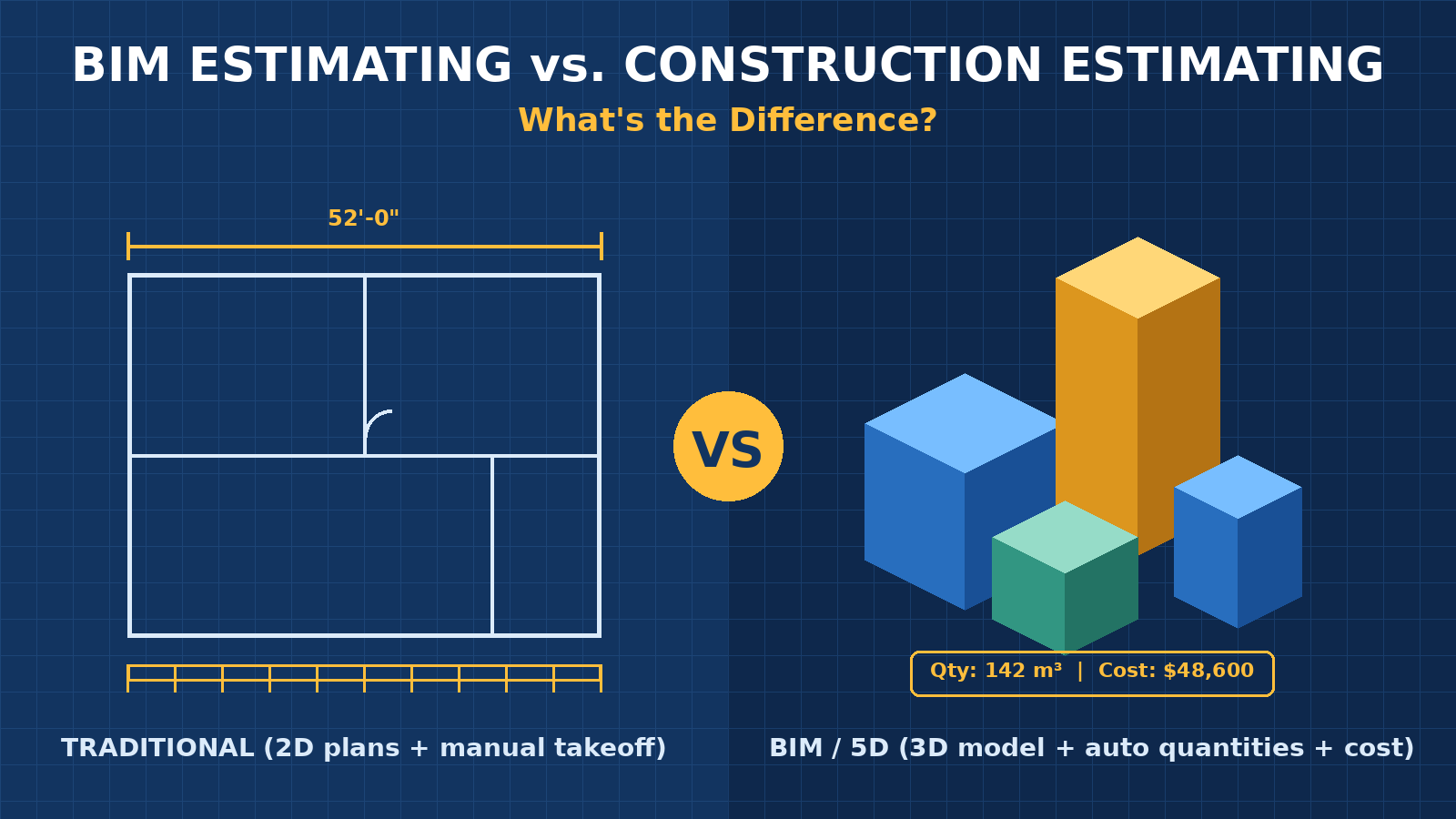
Every construction project begins with a number. Whether you are bidding on a small renovation or a multi-story commercial build, the accuracy of your estimate decides whether you win the work and whether you make a profit. Today, estimators work in two main ways: traditional construction estimating and BIM estimating. Both aim for the same result, but they get there very differently. Understanding the difference helps you pick the right approach for your project, budget, and team.
What Is Traditional Construction Estimating?
Traditional construction estimating relies on 2D drawings, specifications, and manual measurement. An estimator reviews PDF or paper plans, measures quantities such as square footage, linear footage, and counts, and then applies unit costs for labor, materials, and equipment. Most teams use digital takeoff software like PlanSwift, Bluebeam, or On-Screen Takeoff, along with Excel spreadsheets to build the final bid. This method is proven, flexible, and widely understood. It works well for smaller projects, simple designs, and fast-moving bids where a 3D model isn't available. However, it depends heavily on the estimator's attention to detail. A missed sheet, an outdated drawing revision, or a miscounted item can quietly change the budget.
What Is BIM Estimating?
BIM estimating, also called 5D estimating, uses a Building Information Model to pull quantities and costs directly from a 3D digital model. Every element in the model, such as a wall, door, beam, or duct, carries data about its size, material, and type. Software like Autodesk Revit, Navisworks, and Trimble Connect lets estimators extract those quantities automatically and link them to cost databases. The "5D" label comes from adding cost as the fifth dimension to the 3D model, with time (4D scheduling) as the fourth. When the design changes, the model updates, and so do the quantities and costs.
Key Differences
- Source of quantities. Traditional estimating measures from 2D plans, mostly by hand. BIM estimating extracts quantities straight from the 3D model data.
- Speed. Manual takeoff can take days on large projects. BIM can generate quantities in hours once the model is clean and well organized.
- Accuracy.BIM reduces human measurement errors and double counting. Traditional accuracy depends on the estimator's experience and care. That said, BIM is only as good as the model, and a poorly built model produces poor numbers.
- Handling design changes. In traditional workflows, each revision means re-measuring the affected areas. With BIM, an updated model can quickly show what changed and how much it costs.
- Collaboration. BIM puts architects, engineers, estimators, and contractors on one shared model, which helps catch clashes and scope gaps early. Traditional estimating is more siloed.
- Cost and setup. BIM requires software, training, and well-built models, so the upfront investment is higher. Traditional estimating has lower startup costs and a shorter learning curve.
- Visualization. BIM lets you see what you are pricing in 3D, which makes it easier to explain scope to owners. 2D plans are harder to visualize.
When to Use Each Method
Choose traditional estimating when:
- The project is small or straightforward
- Only 2D drawings are available
- The bid deadline is tight and setup time is limited
- Your budget doesn't support BIM software and training
Choose BIM estimating when:
- The project is large, complex, or design-heavy
- The design team already delivers a detailed model
- Frequent design changes are expected
- You need early cost feedback during design
Many contractors use a hybrid approach. They use BIM for quantity extraction and traditional methods to verify results and fill gaps such as site work, allowances, and items that aren't modeled.
Can Outsourcing Help?
Whether you use BIM or traditional methods, you don't have to build the capability in-house. Professional estimating partners can provide quantity takeoff services, BIM-based takeoffs, and trade-specific estimates, so you can bid faster without hiring full-time staff or buying expensive software.
Final Thoughts
BIM estimating and traditional construction estimating aren't rivals so much as tools for different situations. Traditional methods offer simplicity and flexibility, while BIM brings speed, collaboration, and stronger change management. The best choice depends on project size, available data, deadlines, and your team's skills. Whichever method you pick, a careful review process remains essential, because accurate estimates protect your margins and win more bids.